Abstract
Masked diffusion language models (MDLMs) generate text by unmasking tokens in parallel and have recently emerged as alternatives to autoregressive language models. They can be viewed as parallel decoders trained with a position-wise cross-entropy (CE) loss, the same setup as non-autoregressive translation (NAT). In NAT, CE-trained parallel decoders have been argued to be sensitive to small positional shifts, since CE penalizes them harshly. We ask whether CE-trained MDLMs are similarly sensitive to such shifts under iterative decoding. To probe this, we apply a controlled intervention that introduces them during decoding. On LLaDA-8B-Instruct with Arena-Hard, displacing as little as 1% of generated tokens by one position substantially reduces win rates against the unintervened model, showing that MDLMs are sensitive to such small shifts under iterative parallel decoding. Motivated by this, we adapt connectionist temporal classification (CTC), an alignment-flexible objective known to mitigate it there, to MDLM supervised fine-tuning. By relaxing the strict position-wise match that CE imposes, CTC gives the loss room to absorb small positional shifts; concretely, we modify the CTC objective to use a special <slack> token that absorbs positional uncertainty between target tokens and output positions, and an updated collapse map that preserves target surface forms. Across four open-ended generation benchmarks, the resulting model consistently improves over both the original model and a matched cross-entropy-trained baseline, with statistically significant gains on all four. These results identify training-side alignment flexibility as a useful design dimension for MDLM SFT, complementary to the inference-time approaches explored in prior work.
Problem
Standard MDLM training builds positional rigidity into the objective on two sides, and the cross-entropy (CE) loss has no mechanism to absorb small displacements on either.
The output side. Each prediction is aligned to its target at a fixed output position, so a correct token one position away counts as wrong. Non-autoregressive translation (NAT) shares this combination of parallel decoding and position-wise CE, and CE-trained NAT decoders have been argued to be sensitive to small positional shifts.
The context side. The conditioning context around each masked token is assumed to be gold text at gold positions. NAT decodes in a single pass, so only the output side is in play there. MDLMs decode iteratively and irreversibly: a small positional shift introduced at one step enters the conditioning context for every later step, where it is treated as gold.
Whether MDLMs are sensitive to small positional shifts under this regime has not been examined. To test this, we apply a controlled shift intervention while LLaDA-8B-Instruct decodes: a few already-unmasked tokens are swapped with an adjacent masked position, so token identities are preserved and only a one-position shift is introduced. We then compare each intervened output against the same model's unintervened output on Arena-Hard-v2.0.
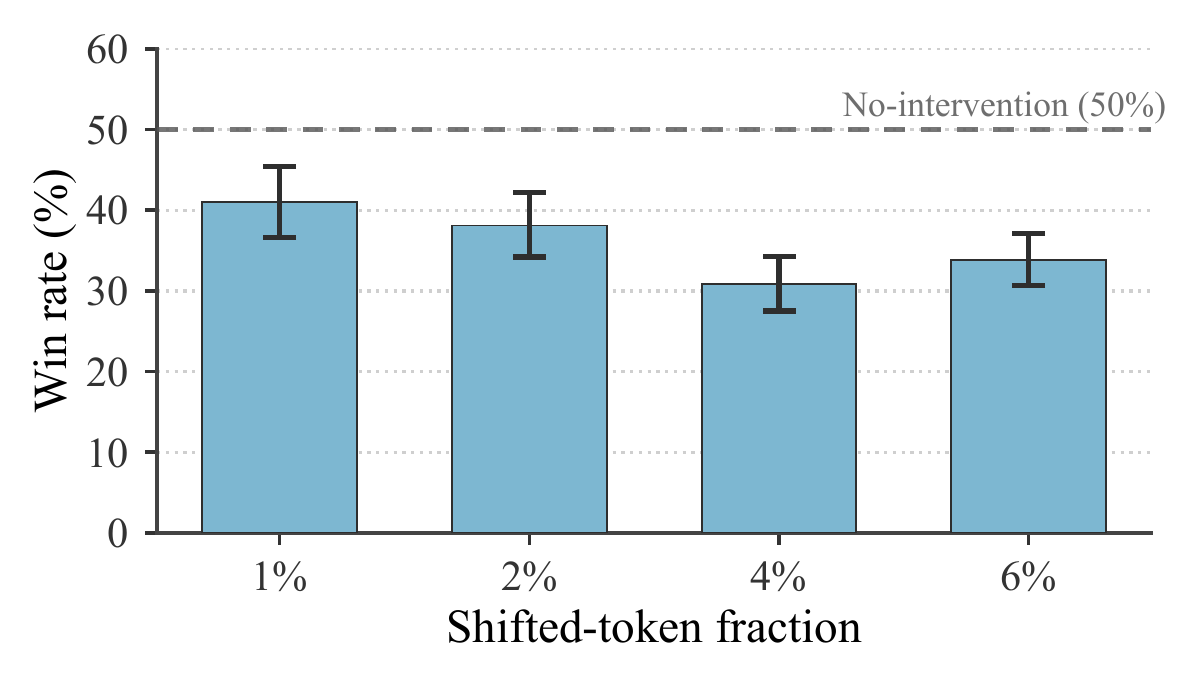
The results show that shifting as little as 1% of generated tokens by a single position drops the win rate well below 50%: MDLMs are sensitive to small positional shifts under iterative parallel decoding.
We also find such shifts when no intervention is applied: of 750 LLaDA-8B-Instruct generations on Arena-Hard-v2.0, 342 (45.6%) contain at least one committed token that the model later predicts at an adjacent position instead. These cases usually surface late in decoding, once more of the surrounding context has been revealed.
Method
We relax position-wise matching with a CTC-inspired loss, using a <slack> token to absorb small positional shifts. In NAT, this sensitivity has been addressed by replacing position-wise CE with connectionist temporal classification (CTC), which lets the model emit blank symbols between content tokens and treats outputs that differ only in blank placement as equivalent. Inspired by this, we add a special <slack> token that plays the role of the blank and is removed from the output after decoding. Given a masked response \(\tilde r_t\) that contains <slack> tokens, our CTC-S loss sums over every alignment \(a\) that the collapse map \(\beta_{\mathrm{slack}}\) turns into the clean response \(r_0\) by removing <slack>:
In training, we insert <slack> tokens at random positions at a ratio \(s = s_{\max}(1-t)\) with \(s_{\max} = 0.5\), and add CTC-S to the standard CE loss: \(\mathcal{L}^{\mathrm{SFT}} = \mathcal{L}^{\mathrm{CE}} + \lambda\, \mathcal{L}^{\mathrm{CTC\text{-}S}}\) with \(\lambda = 0.1\).
Results
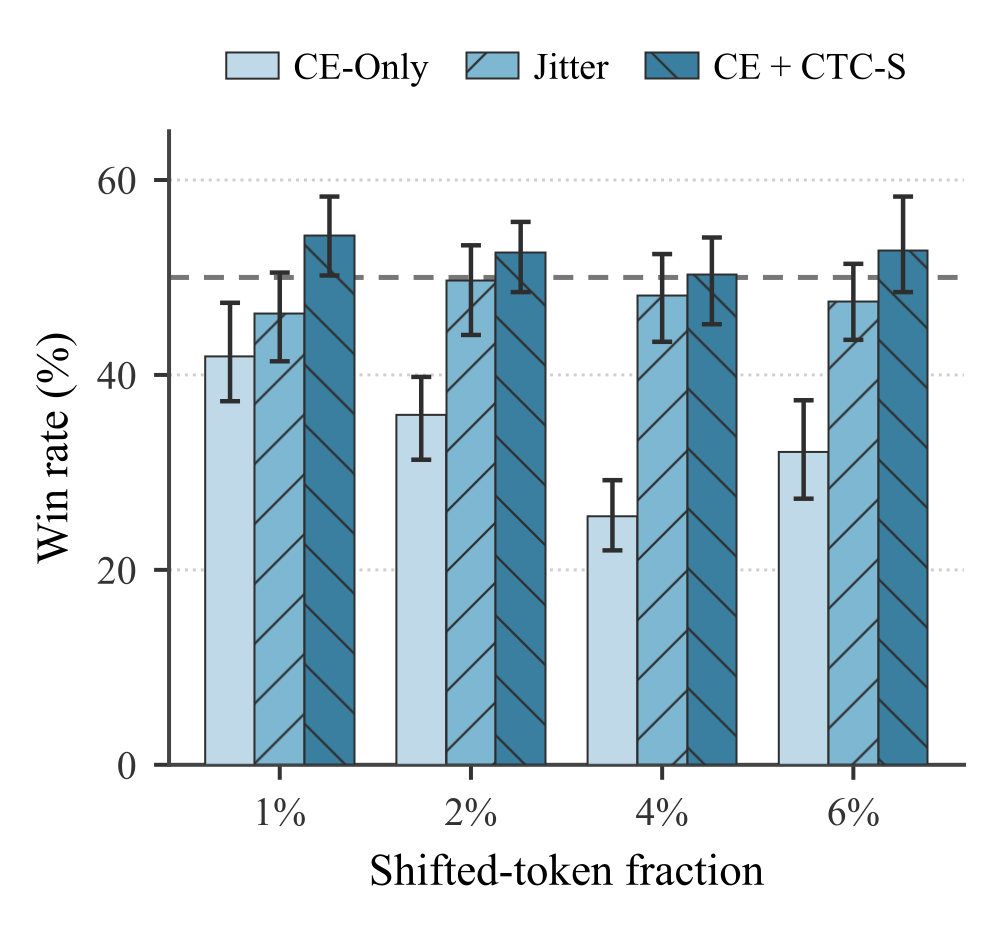
CE + CTC-S improves on all four open-ended generation benchmarks and stays robust under the shift intervention. We fine-tune LLaDA-8B-Instruct on about 291k Magpie-Pro examples and compare three models: CE-Only (standard CE on the same data), Jitter (CE on the same <slack>-augmented data), and CE + CTC-S (ours).
| Model | Arena-Hard* | Creative Writing Bench v3 |
MT-Bench | WildBench |
|---|---|---|---|---|
| LLaDA-8B-Instruct | 43.7 (−1.1 / +1.4) | 23.2 | 2.84 | −5.48 |
| CE-Only | 50.0 (−0.0 / +0.0) | 24.6 | 3.44 | −4.53 |
| Jitter | 48.4 (−1.4 / +1.5) | 25.1 | 3.61 | −4.46 |
| CE + CTC-S (ours) | 55.1†‡ (−1.7 / +1.3) | 27.7†‡ | 4.35†‡ | −4.23†‡ |
Higher is better. *Win rate (%) against CE-Only, with bootstrapped 95% confidence intervals. †/‡: significantly better than CE-Only / Jitter (paired bootstrap, \(p < 0.05\)).
CE + CTC-S is significantly better than both CE-Only and Jitter on every benchmark. Jitter trains on the same <slack>-augmented data but keeps position-wise CE, and its results are mixed: across the three models, the gain concentrates at the one step that makes the objective itself alignment-flexible.
Under the shift intervention from above, CE-Only is nearly as sensitive as the original LLaDA and Jitter stays just below 50%, while CE + CTC-S stays at or above 50% at every shifted-token fraction.
The paper also shows gains on LLaDA-MoE, results on five general-capability benchmarks (GPQA, MMLU, MBPP, IFEval, GSM8K) that match or improve over CE-Only, and better results than block-diffusion baselines tuned per benchmark in five of six comparisons (the sixth is a tie).
Analysis
How the model uses <slack>
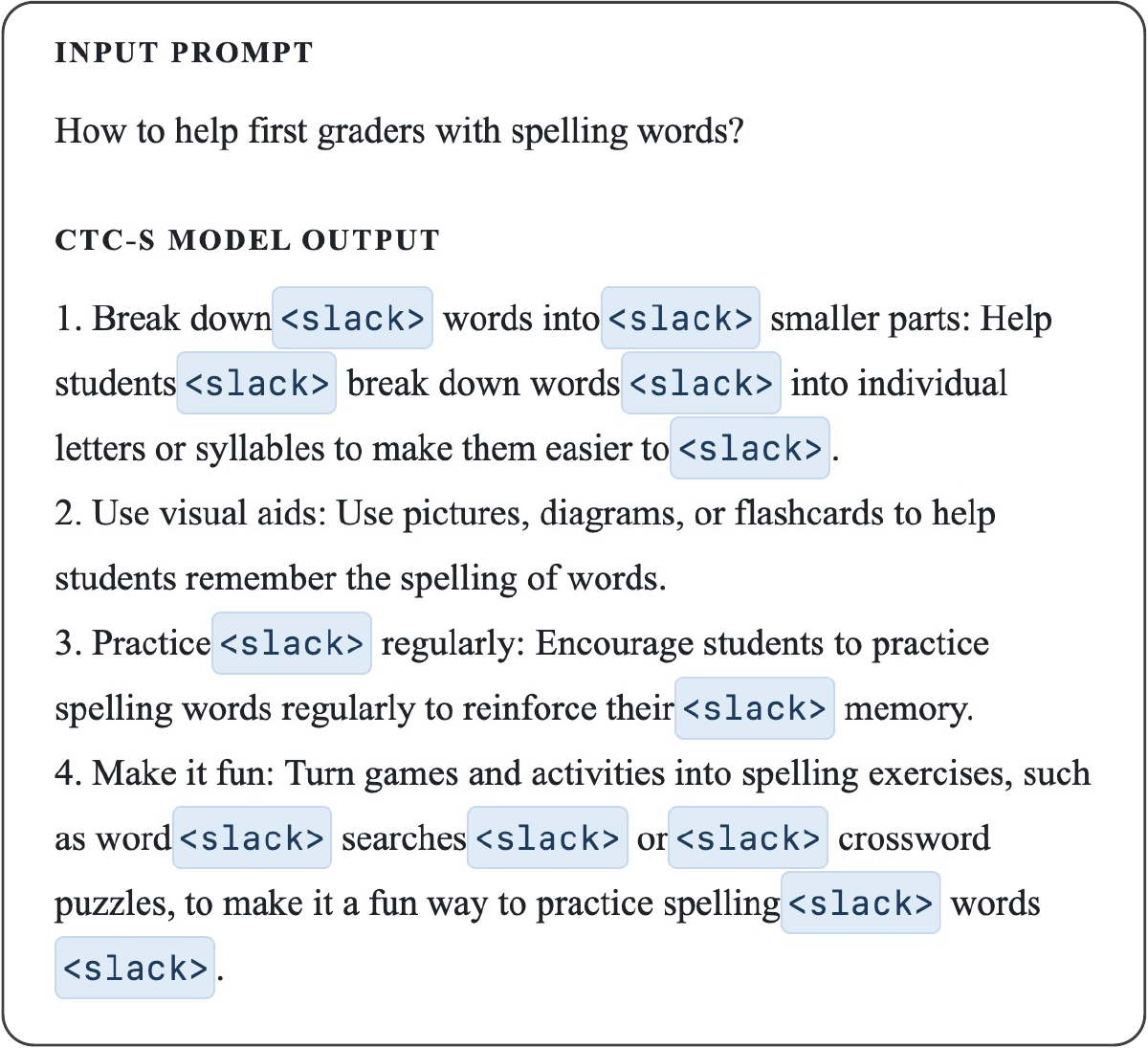
- Selective. Every training response contains <slack>, yet only 83 of 160 MT-Bench outputs (51.9%) use it at all.
- Calibrated. In outputs that use it, <slack> makes up 27.5% of tokens, close to the 25% average rate in training.
- Between words. Training inserts <slack> anywhere, including inside words, yet only 4.9% of emitted <slack> tokens fall inside a word.
Sensitivity to the slack ratio
We fixed \(s_{\max} = 0.5\) in advance rather than tuning it. With \(s_{\max} = 0.2\) or \(0.8\), CE + CTC-S still improves significantly over CE-Only on Creative Writing Bench v3 and MT-Bench. \(s_{\max} = 0.5\) gives the best overall balance, and only \(s_{\max} = 0.2\) is significantly worse than CE-Only on any benchmark (Arena-Hard).
BibTeX
@inproceedings{ye2026reconsidering,
  title={Reconsidering Positional Supervision in Masked Diffusion Language Model Training},
  author={Mengyu Ye and Keito Kudo and Ryosuke Takahashi and Jun Suzuki},
  booktitle={The Fortieth Annual Conference on Neural Information Processing Systems},
  year={2026},
  url={https://arxiv.org/abs/2601.22947}
}